
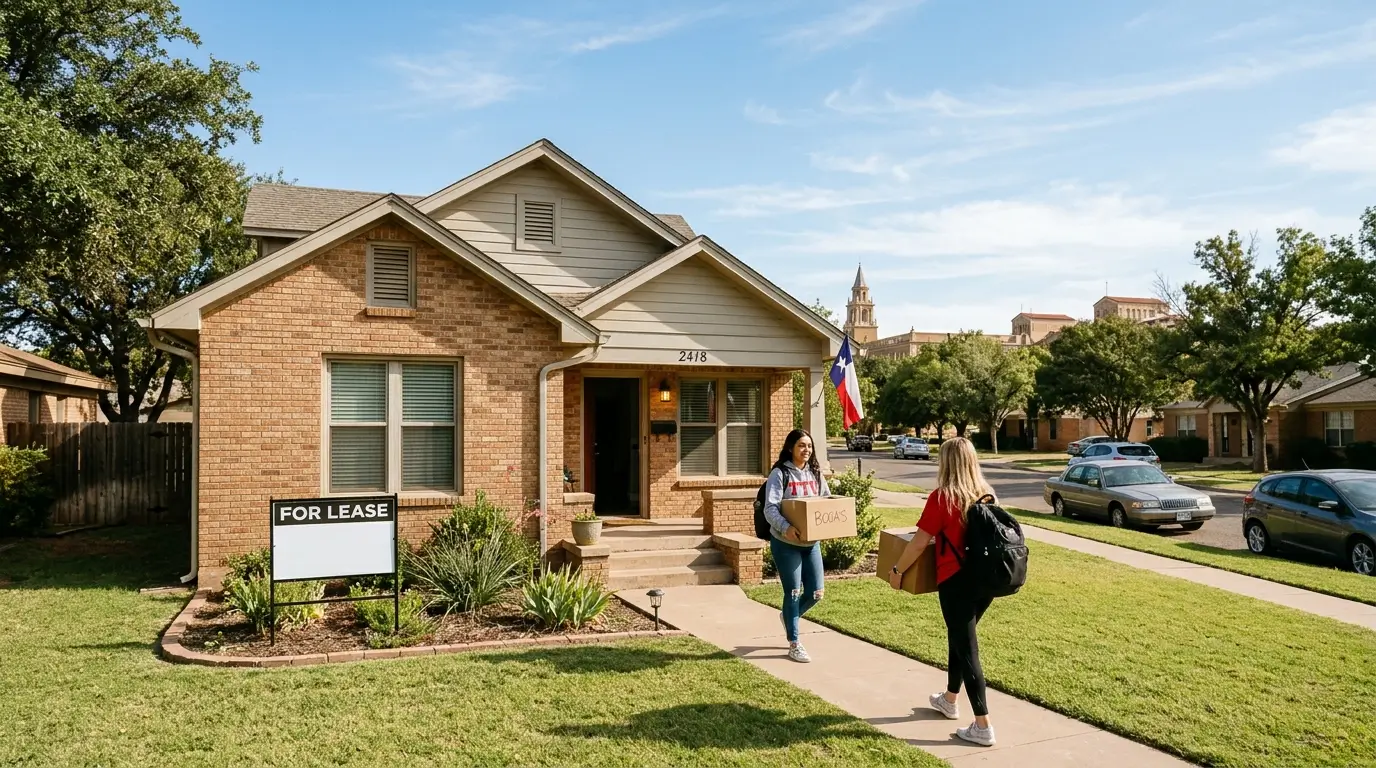
Lubbock’s rental calendar is set partly by Texas Tech. Fall 2026 enrollment reached 46,296 students as of the 20th class day, an increase of 3,841 from a year earlier and the fifth straight year of growth, with a record 9,532 first-time students.
For owners of single-family homes near campus, that scale is an opportunity, but it comes with its own leasing rules of thumb: when to start and end a lease, who signs it, and what happens when the semester ends and the tenants leave.
Key Takeaways
Texas Tech’s fall 2026 enrollment hit a record 46,296, up 3,841 from last year and the fifth consecutive year of growth.
First-year students are required to live in university residence halls unless they qualify for an exemption, so off-campus demand leans toward returning undergraduates, graduate students, and exempt students.
Texas Tech’s academic calendar sets the real turnover windows: fall classes begin in late August, and the spring semester wraps up in early to mid May.
Guarantor, roommate, and replacement-tenant policies should be written down and applied consistently before the unit is listed.
Summer is the biggest controllable cost, since three vacant months equals a quarter of a year’s rent.
Who Actually Rents Off Campus
Texas Tech’s housing office says the university requires enrolled first-year students to live in the residence halls, with an exemption process for students who qualify, and its operating policy lists completing a full academic year in the halls as one path to off-campus eligibility. In practice, that means the renters you’ll meet are mostly sophomores and above, graduate and professional students, and students who qualify for an exemption. Many of them are renting for the first time, often with roommates, and often with limited income or rental history. That profile shapes almost every decision below.
Build Your Lease Dates Around the Academic Calendar
Texas Tech’s 2026-2027 academic calendar, which the university lists as tentative, shows the rhythm clearly. Fall classes begin August 24, the fall term ends with finals in early December and commencement December 11 and 12, spring classes begin January 13, and the spring term ends with finals in early May, followed by commencement in mid-May. Summer runs in two sessions, June 1 through June 30 and July 6 through August 4.
That pattern points to two major turnover windows, May and August, and a smaller one in December for graduating students. A lease that starts after move-in week competes with every other vacant unit in town, so market a home that will turn over in August well before the semester begins, not after.
Guarantors and Co-Signers
Many student applicants don’t have the income or rental history a standard screening would require, which is why a parent or other guarantor is common for student rentals. The key is to treat the guarantor as a real part of the approval. Screen the guarantor on the same income and credit standards you’d apply to any applicant, and have them sign a separate guaranty or lease addendum that spells out what it covers: rent, damages, and whether it carries through a renewal.
Then, apply that policy to every applicant who doesn’t meet your income requirement rather than deciding case by case, since consistency is also your best protection on fair housing. Our tenant screening process is built around applying the same criteria to every applicant.
Roommate Leases and Replacement Tenants
When several students sign one lease, each is typically responsible for the full rent, and that arrangement works well until a roommate wants out. Decide in advance what happens in that situation. Common approaches include requiring written approval of any replacement tenant, running that person through the same screening, and amending the lease in writing rather than letting the remaining roommates sort it out informally. Informal subletting is the usual source of trouble, since the person living in your home may be someone you never screened. Spell out these rules in the lease, keep a single, clear process for rent and deposit handling, and have an attorney review the language you use.
Making Summer Work
Summer is where student rentals most often lose money. The math is simple: three vacant months is 25% of a year’s rent, so a $1,800-a-month home that sits empty from May through July gives up $5,400. Our vacancy calculator lets you run your own numbers. The most direct fix is aligning the lease term with the calendar, so a 12-month lease runs from one August to the next and the summer is covered. If a tenant group won’t commit to 12 months, weigh a slightly lower monthly rate for a full-year term against the cost of a vacant summer, or offer current tenants a summer option, since some students stay for the summer sessions or internships. If the home does turn over in May, use that window productively: paint, flooring, and deferred repairs are easier to handle while it’s empty, and our maintenance team can coordinate that work so the home is ready well before August.
Document the Move-In, Especially With First-Time Renters
Because many student tenants are renting for the first time, their expectations about condition and cleaning can differ widely from yours. A detailed move-in inspection with dated photos, acknowledged by every roommate on the lease, sets a shared baseline and makes the move-out comparison straightforward. We conduct detailed move-in and move-out inspections with full property condition documentation on every home we manage, and the same habit pays off for any owner handling a student rental on their own. It also helps to walk new tenants through basic expectations, such as how to submit a repair request and what is considered normal wear, before the first problem comes up rather than after it.
FAQ
How many students attend Texas Tech?
Texas Tech reported 46,296 students for fall 2026, a record and an increase of 3,841 from the previous year.
Do first-year students rent off campus?
Generally no. Texas Tech requires enrolled first-year students to live in the residence halls unless they qualify for an exemption, so most off-campus renters are returning students, graduate students, or exempt students.
Should I require a guarantor for student tenants?
It’s common when applicants lack income or rental history. Screen the guarantor on the same standards you use for any applicant, document the guaranty in writing, and apply the policy consistently.
When do student leases typically turn over?
Texas Tech’s calendar points to May and August as the main windows, with a smaller one in December around fall commencement.
Planning the Year Before the Semester Starts
A rental near Texas Tech works best when the lease calendar, the screening policy, and the turnover plan are set before the first showing, not after the first vacancy. Owners who line those up can capture the demand a growing university brings without paying for it in empty summers. If you own a home near campus and want help building that calendar and filling the August turn, our Lubbock property management team handles leasing, screening, and the day-to-day work from the first showing to renewal.